

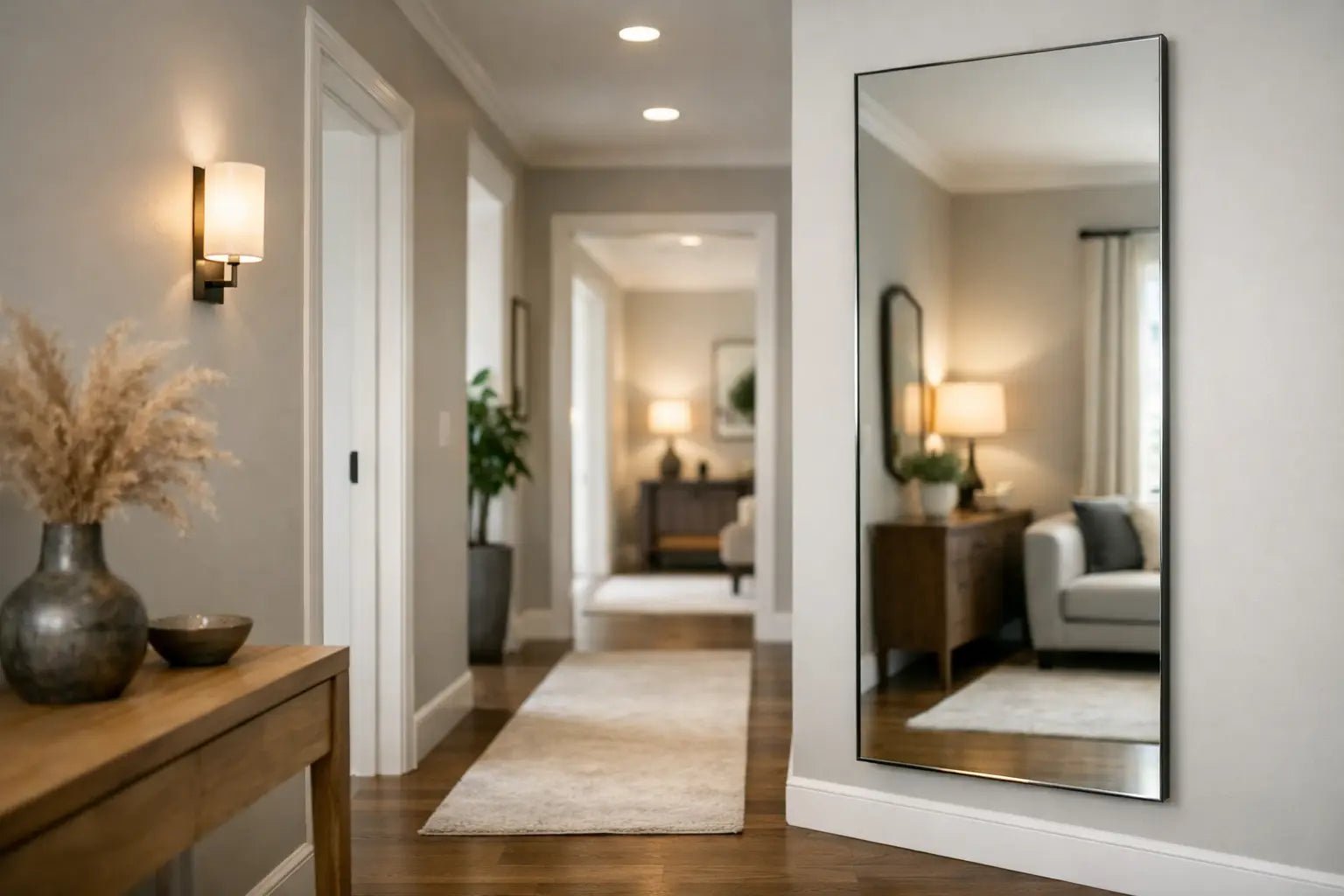
The hallway sets the tone before a single room fully reveals itself. If you are deciding where to place hallway mirror designs in your home, the right spot can brighten a narrow entrance, add balance to an awkward wall and make everyday comings and goings feel far more polished.
Where to place hallway mirror in your home
There is no single rule that works for every hallway. A long Victorian entrance, a compact new-build corridor and a wide open-plan entry all behave differently, so mirror placement should respond to the architecture first and style second.
In most homes, the best position is on a wall that either reflects natural light or gives the eye a pleasing focal point as soon as you enter. That might be opposite a window, above a console table or at the end of a hallway that otherwise feels flat. What matters is not just what the mirror sits on, but what it reflects. A well-placed mirror can double the sense of light and space. A poorly placed one can simply bounce back clutter, coats and the side of a radiator.
If your hallway is narrow, placing a mirror along the side wall usually works better than hanging it at the very end. This keeps the space feeling broader rather than tunnel-like. In a wider entrance hall, a mirror at the far end can be very effective, especially if it draws attention to a lamp table, panelling or another decorative feature.
Use light as your guide
One of the simplest ways to choose a position is to stand in the hallway during the brightest part of the day and see where the light falls. Mirrors are at their best when they lift what is already there. If a nearby window, glazed front door or borrowed light from another room reaches one section of wall, that is often your strongest starting point.
Placing a mirror opposite a window can work beautifully, but it depends on the view and the strength of the light. If the window looks onto greenery, a front garden or a softly lit landing, the reflection adds depth and atmosphere. If it faces bins, parked cars or a harsh beam of direct sun, you may prefer to angle the mirror’s impact more subtly from an adjacent wall instead.
Hallways with little natural light benefit from pairing a mirror with wall lighting or a table lamp below. In those spaces, the mirror is not just decorative. It becomes part of the lighting scheme, helping warm pools of light travel further across the space.
The most practical places for a hallway mirror
For day-to-day living, the most useful spot is often near the front door, where the mirror can serve as a last glance before leaving. This is especially handy in family homes, where coats, scarves and school bags tend to create a busy start and end to the day. A mirror near the entrance adds convenience without needing a separate dressing area.
Above a console table is a classic choice because it creates a natural arrangement rather than a floating object on an empty wall. The table grounds the mirror visually and gives you space for a lamp, tray, vase or candle, which helps the hallway feel considered rather than purely functional. This approach works especially well in medium to wide hallways where there is room to style the area properly.
If your hallway is very tight, a slim vertical mirror on a clear section of wall can be the better option. It offers the practical benefit of a full or near-full reflection without making the space feel crowded. In narrower properties, that restraint often looks more expensive than trying to squeeze in too much furniture.
Scale matters more than most people expect
A mirror can be in the right position and still look wrong if the scale is off. Small mirrors tend to disappear in hallways unless they are part of a grouped arrangement or paired with furniture of similar width. Oversized mirrors can be striking, but only if they do not overpower the wall or obstruct movement.
As a general guide, a mirror above a console should usually be narrower than the console itself. This creates a balanced look and leaves enough visible wall around the frame. If you are hanging a standalone mirror on a blank wall, choose a size that has enough presence to hold its own from the moment you enter the home.
Tall mirrors are especially useful in hallways with high ceilings because they draw the eye upward and emphasise proportion. Round mirrors soften hallways that feel angular or boxy, while rectangular and arched shapes often suit more classic, symmetrical interiors.
Where not to place a hallway mirror
The less glamorous side of mirror placement is knowing what to avoid. Directly opposite the front door can work, but not always. In some homes it creates a pleasing sense of openness. In others, particularly very small entrances, it can feel abrupt and expose the whole space the moment the door opens.
It is also worth avoiding positions that reflect everyday disorder. If the mirror faces a shoe pile, a packed coat rack or the back of a bulky storage bench, it will amplify the busiest part of the hallway rather than improve it. The same goes for mirrors placed too close to light switches, alarm panels or thermostats, which can make even a beautifully designed hallway feel visually interrupted.
Be cautious with mirrors at awkward heights. If the mirror is for practical use, people should be able to see themselves comfortably without stooping or only catching the top of their head. If it is mainly decorative, it still needs to sit in relation to nearby furniture and architectural lines rather than feeling randomly suspended.
Matching mirror placement to hallway style
The best placement also depends on the mood you want the hallway to have. In a traditional interior, a mirror above a painted console, chest or sideboard often feels most natural. It gives the entrance a layered, settled look and sits beautifully alongside wall lights, panelling or a runner.
In a more contemporary home, a single large mirror can do more of the visual work on its own. Leaning styles are popular, but in hallways they need care. If space is limited or the household is busy, a securely wall-mounted mirror is usually the more practical and polished option.
For character-led interiors, the frame becomes part of the placement decision. A carved wooden frame, antique finish or softly distressed painted surround can echo other pieces in the home and make the hallway feel connected to the rooms beyond. This is where a mirror stops being an afterthought and starts behaving like furniture in its own right.
Where to place hallway mirror with other furniture
If your hallway includes a bench, console or chest, treat the mirror as part of a composition. The easiest way to make the area feel cohesive is to centre the mirror over the furniture below, leaving enough breathing room above the surface for styling. Usually, hanging it around 15 to 25 centimetres above the top of the furniture gives a balanced result, though taller pieces and larger frames may need a little more space.
You do not need to fill every wall. Often, one well-positioned mirror paired with one substantial piece of furniture has more impact than several smaller items competing for attention. If the hallway already contains staircase details, artwork, hooks and storage, a simple mirror placement can give the room the pause it needs.
In homes with generous entrance halls, you have more freedom to create a statement. A mirror above a handsome console with a lamp and a pair of decorative accents can make the hallway feel as thoughtfully furnished as the sitting room. For shoppers who value craftsmanship and individuality, this is often where a distinctive mirror frame or characterful painted piece earns its keep.
The finishing decision
When choosing where to place hallway mirror pieces, ask yourself three questions. Does it improve the light, does it make the space more useful, and does it reflect something worth seeing? If the answer to all three is yes, you are usually in the right place.
A hallway mirror should do more than fill an empty wall. It should bring light, proportion and a sense of welcome to one of the hardest-working parts of the home. Get the position right, and even the briefest walk through the front door feels a little more elegant.


